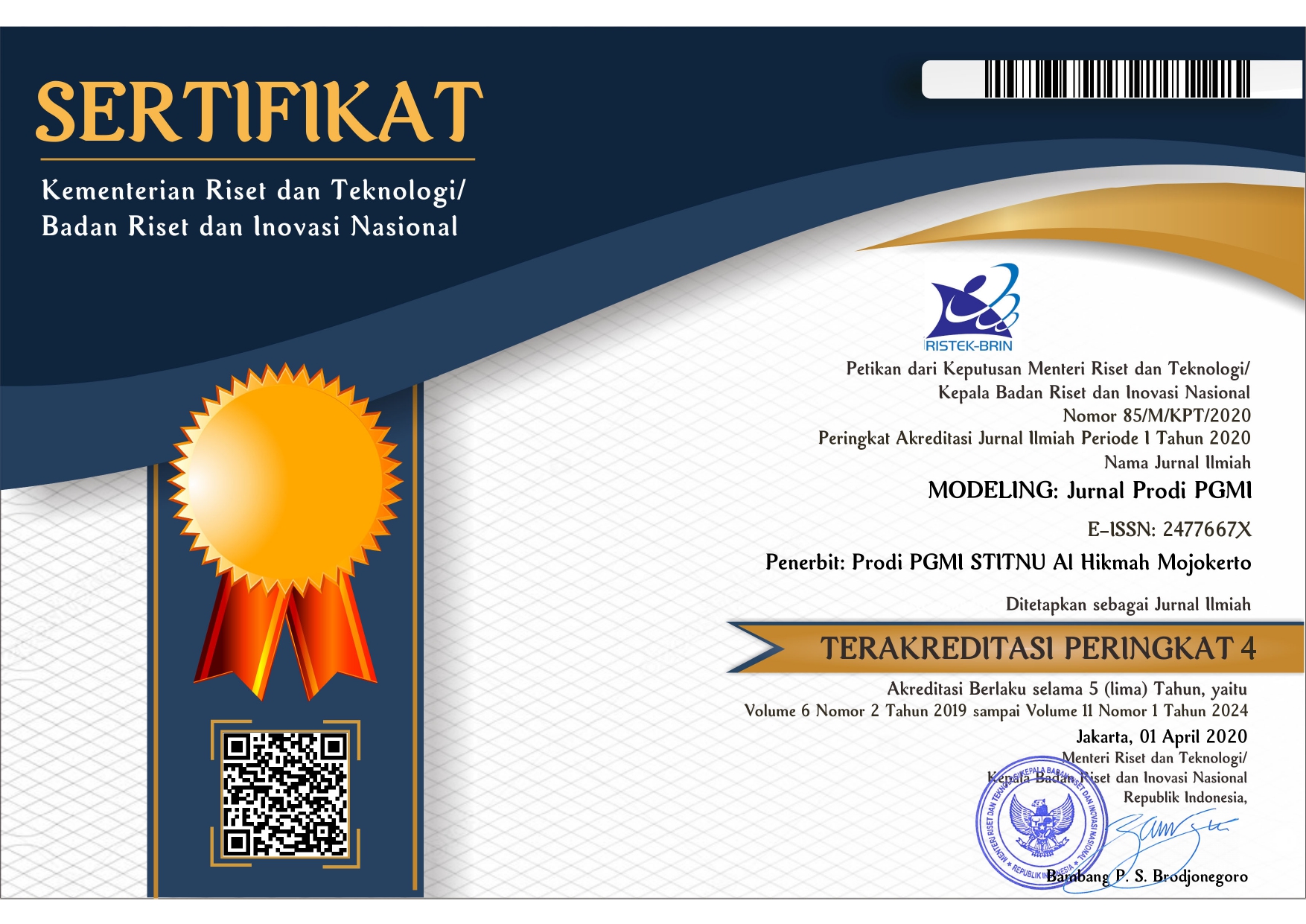
Pelaksanaan Cyber Counseling di SMPN 59 Surabaya pada Masa Pandemi Covid-19
DOI:
https://doi.org/10.69896/modeling.v9i3.1208Keywords:
Cyber Counseling, Pandemic, Covid-19Abstract
The are many problems in online learning experienced by students and teacher consequence to Covid-19, presents its own challenges for guidance counseling teacher. Various efforts have been made by guidance and counseling teacher in order to help solve the problem faced by students during the pandemic through Cyber Counseling. This is the background for researchers to conduct e-counseling research conducted by guidance and counseling teacher. This study aims to describe the cyber counseling process carried out by guidance and counseling teachers during the Covid-19 pandemic.
This research uses a qualitative approach and descriptive method. The location of this research in SMPN 59 Surabaya City with purposive sampling technique. Respondents in this research were homeroom teacher for grades VII, VIII, IX, two guidance and counseling teachers and students in grades VII, VIII, IX at SMPN 59 Surabaya. Research data obtained through observation, interviews and documentation. While the data analysis technique in this research is the Miles and Huberman (Interactive Model)
The results of this research describe the Cyber Counseling method carried out by guidance and counseling teachers for students who have problems during the Covid-19 pandemic. Cyber Counseling can help solve problems faced by students during the Covid-19 pandemic. The advantage of Cyber Counseling is that it can be carried out anywhere and anytime. Meanwhile, the weakness of Cyber Counseling, if it is held for a long time and the application is heavy, it requires memory space and excess quota. However, this can be overcome with contributions from the school who facilitate handphone for those whose handphone do not support or because they are experiencing financial problems and provide free internet package quotas in order to support the implementation of Cyber Counseling.
Downloads
References
Badia, A., Garcia, C. and Meneses, J. (2017). Approaches to teaching online: exploring factors influencing teachers in a fully online university. British Journal of Educational Technology. v.48, n.6
Budianto, dkk. (2019). ICT Application in Cyber counseling as a Teacher Accelerator with Optimizing WhatsApp Based Mobile Computing. Journal of Physics: Conference Series. v.1, n.1
Cash, Scottye J, dkk. (2020). “I’m here to listen and want you to know I am a mandated reporterâ€: Understanding how text message-based crisis counselors. Elsevier. facilitate child maltreatment disclosures
Creswell, John W. (2016). Research Design: Pendekatan Metode Kulitatif, Kuantitatif dan Campuran. Edisi keempat. Yogyakarta: Pustaka Belajar.
Gading, I. (2020). The Development of Cyber counseling as a Counseling Service Model for High School Students in the Digital Age. JPI. v.9 n.2
Hardani, dkk (2020). Buku Metode Penelitian Kualitatif & Kuantitatif. Publisher: CV. Pustaka Ilmu GroupISBN: 978-623-7066-33-0
Johnson-Lutz, H., Sessoms-Penny, S., Schneider, J. and Underdahl, L. (2015), “Best practices relating to student persistence, motivation, and retention in online MBA programsâ€, The Exchange, Vol. 4 No. 2.
Marthaningrum, E. (2020). Problematika Pembelajaran E-Learning Bagi Guru Kelas Rendah di Tengah Pandemi Covid-19. Surakarta
Mashuri, Kahar. (2020). Strategi Pembelajaran Daring Guru Sekolah Menengah Pertama Di Era Covid-19. Stabat: Jurnal Berbasis Sosial, v.1, n.2, Desember 2020:10-18.
Maili, T, dkk (2020). Temporal Patterns of Initial Submissions to Online Counseling When Do People Seek Internet Counseling? Exploring the Temporal Patterns of Initial Submissions to Online Counseling Services. Journal of Technology in Human Services. v.38, n.2.
Masudi. (2015). Bimbingan dan Konseling Perspektif Sekolah. Cirebon: Nurjati Press.
McCluskey, U dan O’Toole, M. (2019). Transference and counter transference from an attachment perspective: A guide for professional caregivers. Routledge.
Mustika, Ade A. (2018). Kemampuan Guru Sekolah Dasar dalam Sistem Penilaian Kurikulum 2013 Kabupaten Tuban (Studi Komparasi Sekolah Induk Kluster Pelaksana K-13). v.6, n.6. Surabaya: Jurnal PGSD
Nakhma’ussolikhah. (2017). Studi Tentang Penggunaan Cybercounseling Untuk Layanan Konseling Individual Bersama Mahasiswa Program Studi Bimbingan Dan Konseling UNU Cirebon. v.2, n.1. Cirebon: OASIS: Jurnal Ilmiah Kajian Islam
Pasmawati, Hermi. (2016). Cyber Counselling Sebagai Metode Pengembangan Layanan Konseling di Era Global. Syi’ar. v.16. n.1
Puspita, Dinda. dkk. (2019). Pengaruh Layanan Konseling Kelompok Berbasis Cyber counseling Via WhatsappTerhadap Keterbukaan Diri Mahasiswa Bimbingan dan Konseling Semester 4A. Bengkulu: Jurnal Universitas Bengkulu. v.2, n.3. ISSN 2620-5343
Prawanti, L dan Sumarni. (2020). Kendala Pembelajaran Daring Selama Pandemi Covid-19. Semarang: Seminar Nasional Pascasarjana 2020.
Purwanto, Agus. dkk. (2020). Studi Eksploratif Dampak Pandemi COVID-19 Terhadap Proses Pembelajaran Online di Sekolah Dasar. Journal of Education, Psychology, and Counseling. v.2, n.1: 1-12. ISSN: 2716-4446.
Sadikin, Ali. (2020). Pembelajaran Daring di Tengah Wabah Covid-19. Jambi:Jurnal Ilmiah Pendidikan Biologi. v.6, n.2, Juni 2020: 214-224.
Safrizal. (2015). Fungsi Layanan Konseling Individu dalam Menuntaskan Masalah Pribadi Peserta Didik di MAN Sibreh Aceh. Banda Aceh
Saroh, Fatmala Eva. (2019). Cyber counseling Bagi Remaja di Youth Center Griya Muda PKBI Kota Semarang (Analisis Metode Bimbingan dan Penyuluhan Islam). Semarang
Suhertina. (2014). Dasar-Dasar Bimbingan dan Konseling. Pekanbaru: CV. Mutiara Pesisir Sumatra
Sutijono, Farid (2018) “Cyber Counseling di Era Generasi Milenial†in SOSIOHUMANIKA: Jurnal Pendidikan Sains Sosial dan Kemanusiaan, Volume 11(1), May, pp.19-32. Bandung, Indonesia: Minda Masagi Press and UNIPA Surabaya, ISSN 1979-0112
Sloan, D. M., Gallagher, M. W., Feinstein, B. A., Lee, D. J., & Pruneau, G. M. (2011). Efficacy of telehealth treatments for posttraumatic stress-related symptoms: A meta-analysis. Cognitive Behaviour Counselling, 40, 111–125
Ulfiah, U. (2018). Functional Requirements Analysis of E-Counseling. Journal of Theoritical and Applied Information Technology, Vol 96, No 18.
Wati, Ina Ambar. (2018). Layanan Bimbingan Konseling Pribadi Sosial dalam Menubuhkan Sikap Positif Siswa. Yogyakarta: Al-Tazkiah v.7, n.2
Wahyuningtyas, Izzati, dkk (2021). Pelayanan Konseling Kelompok Dalam Menangani Kasus Bullying. Surabaya. Counseling As Syamil, Vol. I, No.01, 2021. hlm. 34 -47.